
This is one of the recipes in my family’s regular dinner rotation. Bing, or savory pancakes, fill a role in many Chinese homes that feels a little like pizza does elsewhere. You could even think of pizza as an open-faced bing.
For these pork and onion pancakes, the filling is enclosed inside the dough, which helps keep it juicy as it cooks. The layered structure makes them especially fun to eat, with crisp, golden edges and savory pork tucked between the folds. I love the contrast of the flaky crust and juicy filling, and luckily for me, my kids love them too.
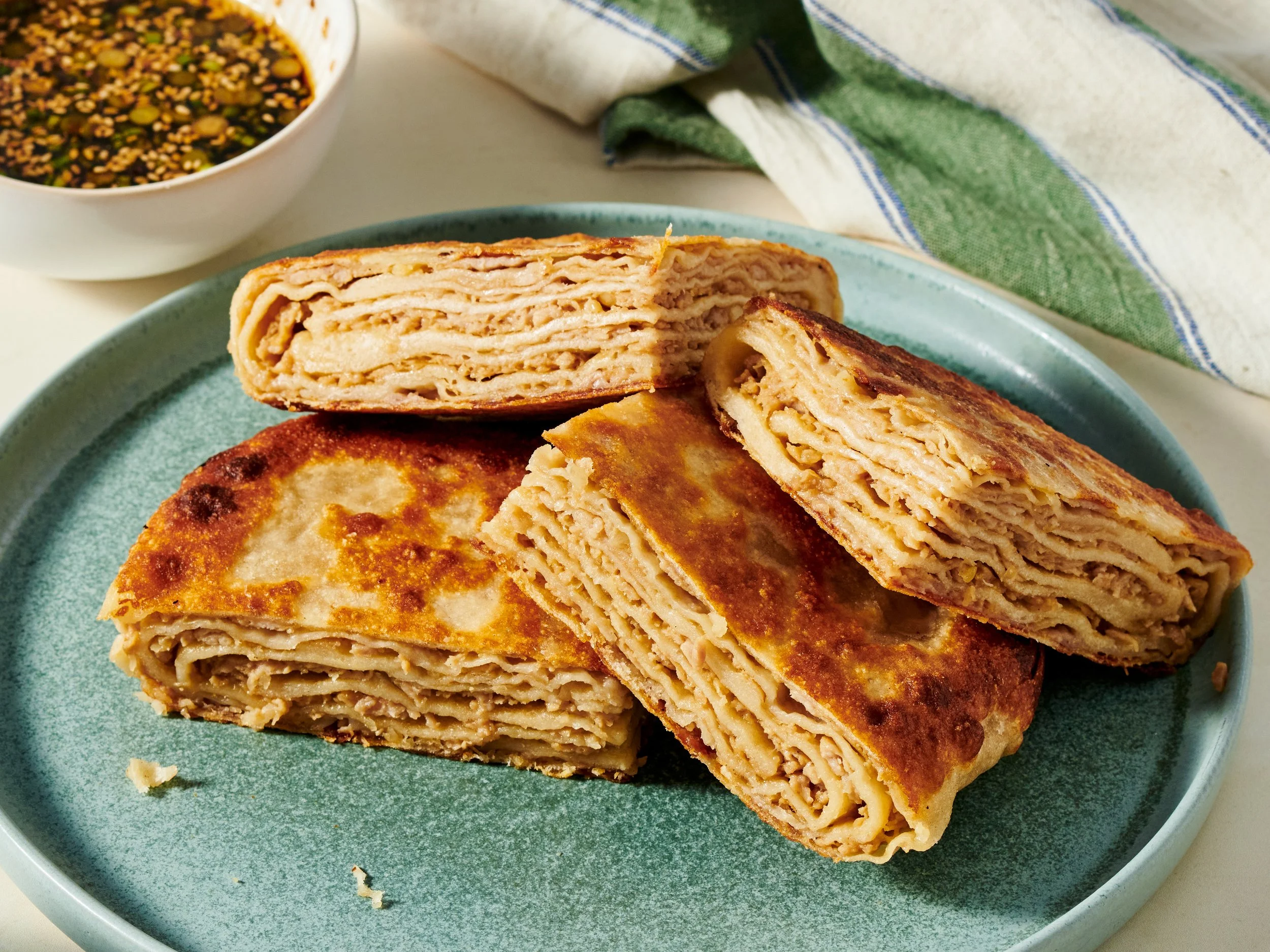
Prep Time: 35 minutes
Rest Time: 1 hour 20 minutes
Cook Time: About 10 minutes
Yield: 1 large pancake, about 4 servings
Ingredients:
450 g all-purpose flour
140 g boiling water
140 g room-temperature water
3 g sea salt
1 recipe All-Purpose Pork Filling
2 tablespoons neutral oil, or as needed, for cooking
1 recipe Soy Dipping Sauce, optional
Directions:
Place the flour in a medium bowl. Slowly pour in the boiling water while stirring with a fork until the water is absorbed and shaggy clumps form.
Add the room-temperature water and salt and continue stirring until the liquid is absorbed. Knead the dough by hand until all the flour is hydrated and the dough forms a smooth ball, about 5 minutes.
Cover and let the dough rest at room temperature for 1 hour.
On a lightly floured surface, roll the dough into a 13-by-15-inch rectangle.
Spread the pork filling evenly over the dough, leaving a ½-inch border around all four sides.
Imagine the rectangle divided into a 3-by-3 grid, like a computer numeric keypad:
7 | 8 | 94 | 5 | 6
1 | 2 | 3
Make four cuts along the horizontal dividing lines: between 1 and 4, between 4 and 7, between 3 and 6, and between 6 and 9, stopping when you reach the center column.
Fold section 1 over section 2, then fold section 3 over section 2. Fold the stacked section 2 up over section 5.
Fold section 4 over section 5, then fold section 6 over section 5. Fold the stacked section 5 up over section 8.
Fold section 7 over section 8, then fold section 9 over section 8. Lightly pinch the exposed edges together to seal.
Cover and let the folded pancake rest for 20 minutes.
Gently press the pancake down with your hands, then carefully roll it to about 6 by 8 inches, taking care not to squeeze out the filling.
Heat a 10-inch cast-iron skillet over medium heat. Add 2 tablespoons oil and place the pancake in the skillet.
Cook until the first side is golden, about 3 minutes. Carefully flip and cook the second side until golden, about 3 minutes more. Adjust the heat as needed and continue cooking until the center reaches about 190°F.
If the outside darkens too quickly, transfer the skillet to a 350°F oven and continue cooking until the center reaches temperature.
Let the pancake cool for about 5 minutes, then cut into 4 pieces. Serve warm, with Soy Dipping Sauce on the side, if desired.
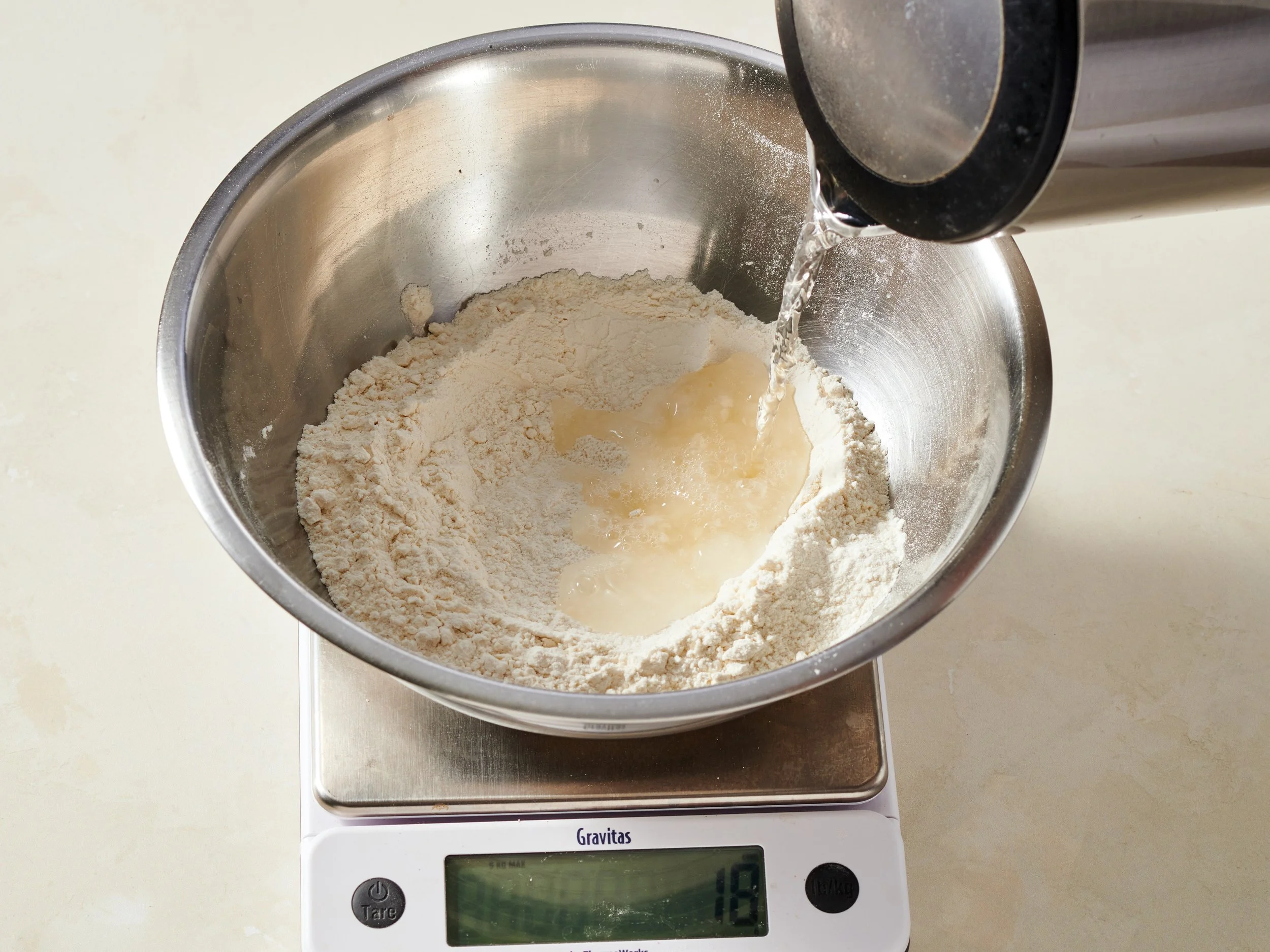
Place the bowl of flour directly on the scale and pour in the boiling water by weight. This is the easiest way to measure it accurately without transferring hot water between containers.
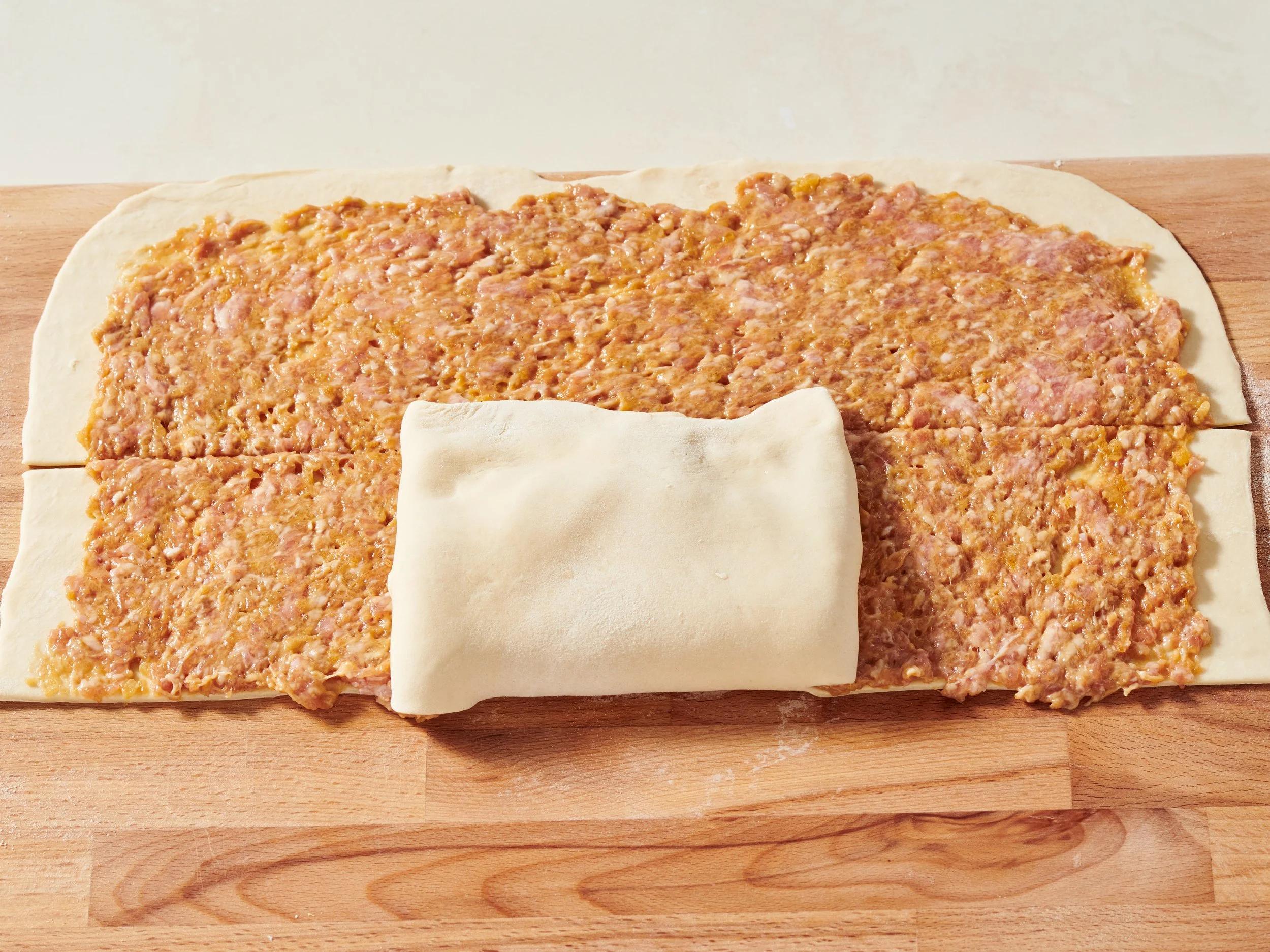
Section 2 folded up over section 5, enclosing the first layers of pork filling.
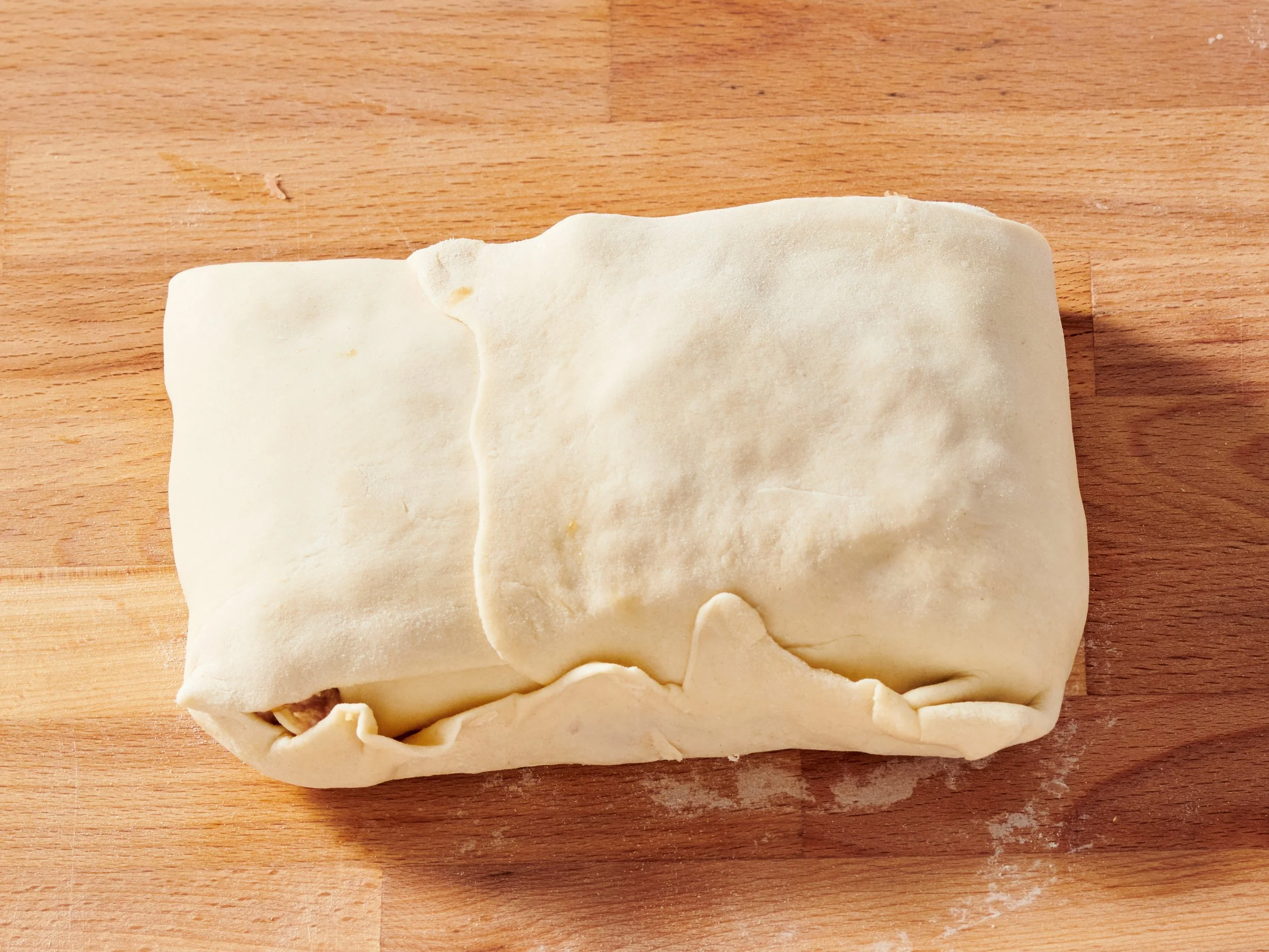
The fully folded pancake with the edges lightly pinched together to seal.
A little filling peeking out is perfectly fine.
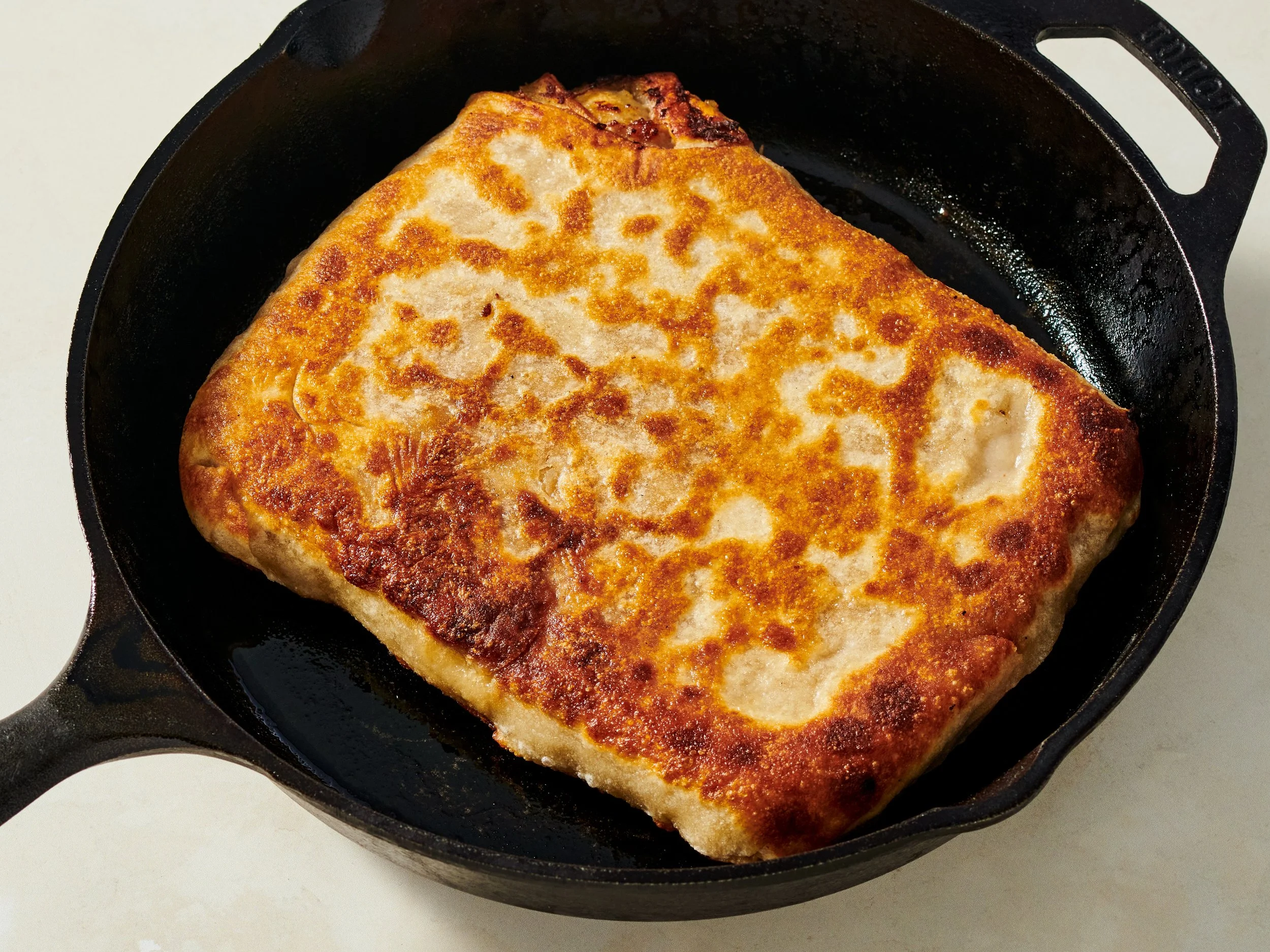
The cooked pancake should be golden brown and crisp on the outside.
I like using a cast-iron skillet for this because it holds steady heat well, but any heavy skillet will work.
Notes:
About the dough: Using both boiling and room-temperature water creates a partially scalded dough. The hot water limits some gluten development, while the cooler water allows enough gluten to form for the dough to stay stretchy and easy to roll. The result is a tender dough that can still hold up to the folding and layering.
About the internal temperature: Ground pork is safe to eat at 160°F, but for this thick, layered pancake, I prefer cooking the center to around 190°F so the dough layers are fully cooked. The pork filling contains baking soda and cornstarch, which help it stay tender and retain moisture even at the higher finishing temperature. If the exterior browns too quickly before the center is done, finish the pancake in a 350°F oven.
About dipping sauce: The pancake is flavorful enough to eat on its own, so the Soy Dipping Sauce is completely optional.
Reheating cooked pancakes: For reheating, warm the pancake in a skillet over medium-low heat until heated through and crisp on both sides. My dad has always preferred them reheated this way. An air fryer also works well. If you’re in a rush, the microwave works too, though the crust will soften.
Make ahead: To make ahead, assemble and shape the pancake, then freeze it uncooked. Once firm, wrap well and freeze for up to 1 month. Cook directly from frozen over slightly lower heat, allowing extra time for the center to cook through.
